

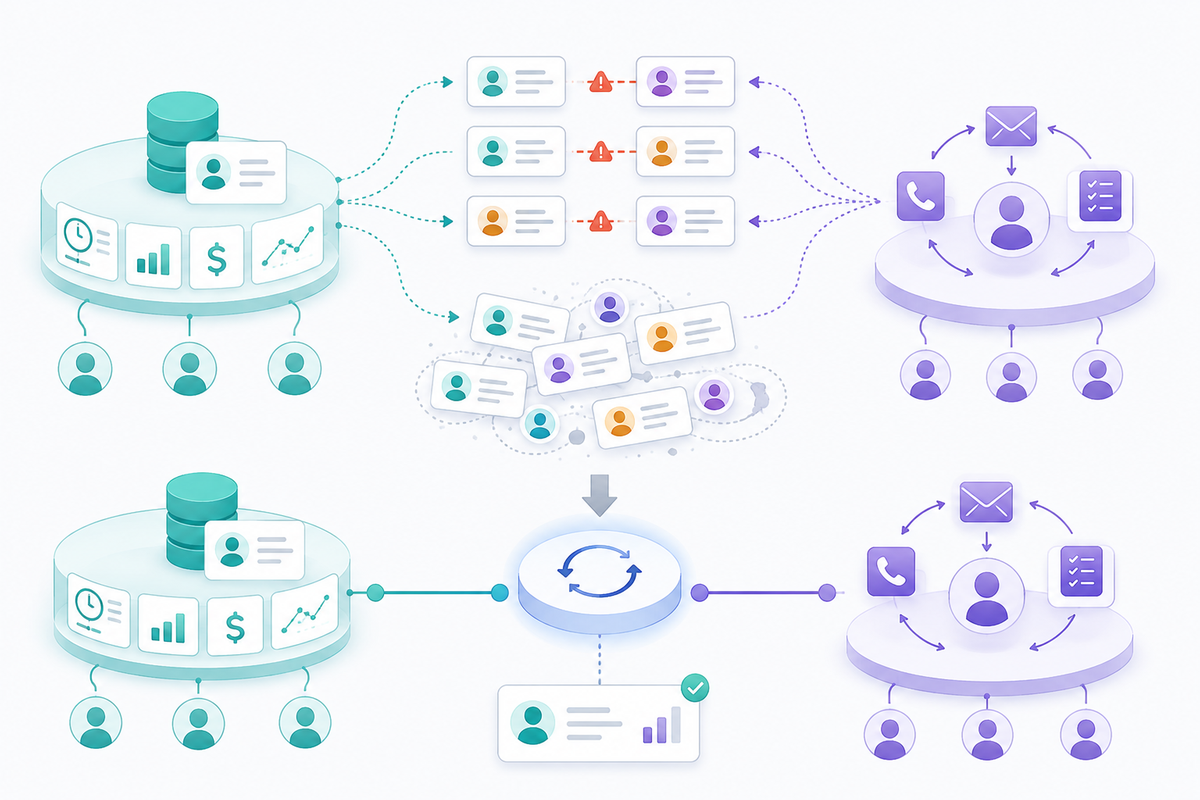
CRM should preserve the shared history of customers, opportunities and the revenue outlook. Sales-engagement tools, by contrast, manage everyday outreach, contact sequences and the salesperson’s work. In larger teams, the two types of systems complement each other, but their integration must be governed. Otherwise duplicates, inconsistent data and reports that management cannot trust emerge.
Sales technology is easy to judge by the number of features it offers. A more important question is which problem a particular system is supposed to solve.
HubSpot distinguishes two basic layers. CRM serves as the central record of contacts, companies, opportunities and relationship history. Management uses it to see the state of the sales pipeline, forecasts and a shared view across departments. A sales-engagement platform, by contrast, focuses on the day-to-day work of salespeople: sequences of emails and calls, automated tasks, multistep contact scenarios and activity tracking.
A smaller team may not need to buy both layers. If the company mainly needs reliable opportunity records, a revenue outlook and shared data, it makes sense to start with CRM. If the main constraint is a high volume of outbound prospecting, a tool for managing that work may take priority. In larger B2B teams that both process inbound inquiries and actively seek new customers, the needs for the two systems usually begin to overlap.
The biggest problem then is not buying the second system itself but the data architecture. Without clear synchronization rules, duplicate contacts, different values in the same fields and blind spots in reporting appear. A salesperson may see one activity history while management is working with a different picture of the opportunity.
In practice, therefore, determine ownership of individual data elements before making the purchase. Which system is the primary source for the customer’s address? Where is a new contact created? Where does the opportunity stage change? What happens if a user edits the same information in both applications? Without these answers, integration merely accelerates the creation of disorder.
Connections to marketing, customer service and finance are equally important. CRM has value precisely because it provides a shared history to people outside the sales team as well. A tool focused on salesperson activity has a much narrower purpose. One should therefore not automatically be treated as a replacement for the other.
HubSpot notes that alignment between marketing and sales remains a significant problem and that most sales teams also see AI as a way to save time and optimize processes. The benefit of automation quickly disappears, however, if the salesperson then spends the time saved fixing inconsistent data.
Do not start the sales technology plan with a list of vendors. Start with a description of data flows and the responsibilities of each system. Only then can you make a sensible decision about whether you actually need a second platform.
KEY TERMS
- CRM: The central system for recording customers, opportunities, relationship history and the revenue outlook.
- Sales-engagement platform: A tool focused on everyday customer outreach and on managing sequences of sales activities.
- System of record: The system whose value for a specific data item is treated as authoritative.
- Data synchronization: The governed transfer of changes between connected systems.